
Cracked concrete steps are usually caused by freeze-thaw cycles, a weak or settled base, poor drainage, and de-icing salt. Hairline cracks are mostly cosmetic and can often be sealed. Wide cracks, uneven treads, or steps pulling away from the house need a proper repair or rebuild. Platinum Brick and Block LLC is a licensed and insured concrete contractor in Newark, NJ, and has repaired and built concrete steps across North Jersey since 2000.
This guide explains why concrete steps crack, how to read the damage, which cracks are a safety problem, and when repair makes more sense than replacement.
Cracked Concrete Steps at a Glance
- The most common cause in New Jersey is water getting into the concrete, freezing, and expanding.
- Hairline cracks are usually cosmetic. Seal them and keep an eye on them.
- Steps that move, tilt, or pull away from the house are a safety problem and should be checked soon.
- Repair works when the base underneath is still solid. Rebuilding is the better fix when the base has failed.
- Skip rock salt on new concrete during its first winter.
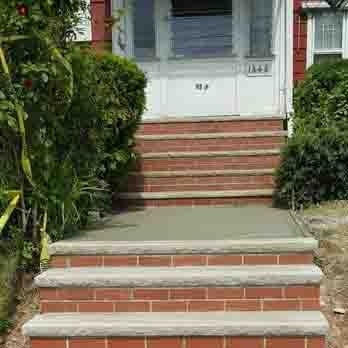
What Causes Cracked Concrete Steps?
Seven things cause most cracked concrete steps. They often work together over several winters, so a crack usually has more than one cause.
- Freeze-Thaw Cycles
Freeze-thaw damage happens when water gets into the concrete, freezes, and expands. When it thaws, more water gets in. After a few New Jersey winters, a hairline crack can turn into one wide enough to slide a coin into.
- A Weak or Settled Base
Steps need solid ground under them. If the soil was not compacted properly, or if water slowly washes soil away from under the steps, they can sink or tilt. Concrete does not bend, so it cracks.
- Poor Drainage
A downspout that empties next to the steps, or a yard that slopes toward the entrance, keeps the concrete and the soil under it wet. Wet soil softens, and wet concrete takes in more water to freeze. Fixing the drainage is often as important as fixing the steps.
- De-Icing Salt
Rock salt melts ice, but it also makes freeze-thaw damage worse. The National Ready Mixed Concrete Association explains that de-icing chemicals increase how saturated the surface gets, and it recommends avoiding them on new concrete during its first winter. Salt is a common reason the top layer of concrete flakes or scales off.
- Shrinkage in New Concrete
Concrete shrinks a little as it dries. If it dries too fast, or if the steps were poured without joints in the right places, cracks can show up within the first year or two.
- Heavy Loads and Impact
Moving furniture, a heavy planter, or a delivery that bangs the edge of a tread can chip or crack a corner, especially if the concrete is already weakened.
- Tree Roots and Frost Heave
Roots growing under or beside the steps can push on the concrete over time. So can frost heave, where the ground itself lifts as it freezes.
Age plays a part too. Even well-built steps wear down after decades, and some cracking and surface wear is normal.
What Do Different Cracks in Concrete Steps Mean?
Not every crack tells the same story. This table shows what each type usually points to and how quickly it needs attention.
| What you see | What it usually means | How urgent it is |
|---|---|---|
| Hairline crack | Shrinkage or minor surface wear | Low. Seal it and watch it. |
| Flaking or scaling surface | Freeze-thaw or salt damage to the top layer | Low to medium. Repair or resurface before winter. |
| Crack wide enough for a coin | Water is getting in | Medium. Repair it before the next freeze. |
| One side higher than the other | Settling or ground movement | High. Have the base checked. |
| Broken or missing corner | Impact, or water freezing at the edge | Medium. It is a trip hazard if the corner is gone. |
| Gap between the steps and the house | The steps are moving away from the building | High. Get it looked at soon. |
How to Check Your Cracked Concrete Steps Yourself
You do not need tools to get a first read on the damage. A quick check on a dry day takes about ten minutes.
- Stand back and look at the steps from the side. Check whether every tread sits level with the next one.
- Look at the gap where the steps meet the house or the landing. A gap that is growing is a warning sign.
- Walk up the steps slowly and listen for a hollow sound or feel for any rocking.
- Hold a coin against the widest crack. If the coin slides in, water is getting in.
- Look at where the roof and downspouts send water. It should flow away from the steps, not toward them.
- Take photos with the date. They make it easy to see whether a crack is changing from one season to the next.
If anything on that list worries you, it is worth having a contractor look at it before winter.
Are Cracked Concrete Steps Dangerous?
Not always. A hairline crack is rarely dangerous. A step that moves, tilts, or breaks apart is. Get the steps checked soon if you notice any of these:
- A step that moves, rocks, or feels hollow when you stand on it
- Steps that are visibly tilting or sinking
- A gap opening between the steps and the house
- Broken or missing sections that leave an uneven surface
- A wobbly railing attached to cracked concrete
Stay off the damaged areas where you can. Steps are where people slip and fall, and a small fix now is much easier than dealing with an injury later.
Can You Repair Cracked Concrete Steps?
Yes, in many cases. You can repair cracked concrete steps when the base underneath is still solid and the damage is limited to the surface or a single area. Our concrete steps repair service starts with a close look at the steps, not an assumption that everything has to come out.
Here is how it usually breaks down:
- Surface cracks and chips can often be cleaned out, filled, and patched. A good concrete step crack repair can make steps look and feel solid again.
- Worn or flaking surfaces may be a candidate for resurfacing, as long as the concrete underneath is still sound.
- Settled, tilting, or separated steps are a different story. If the base has failed, patching the top will not hold.
Repair or Replace? How to Decide
Repair is usually the right call when:
- The steps are still level and solid
- The cracks are thin or limited to one area
- The damage is on the surface, such as flaking or small chips
Replacement is usually the better call when:
- The steps are sinking, tilting, or pulling away from the house
- The cracks are wide, spread across the steps, or keep coming back
- The base has failed, so a patch would crack again
When rebuilding is the answer, we also handle concrete step installation for new outdoor concrete steps, built on a proper base.
How Does Concrete Step Crack Repair Work?
A typical repair follows these steps:
- Inspect the steps and find out what caused the crack.
- Clean loose material out of the crack and the damaged area.
- Fill or patch the damage with a repair material suited to concrete.
- Finish the patch so it blends with the surrounding surface.
- Let the repair cure fully, then seal the surface to help keep water out.
The goal is to fix the cause, not just cover the crack. A patch over a moving step will crack again.
How to Prevent Cracked Concrete Steps in New Jersey Winters
You cannot stop concrete from aging, but you can slow the damage down.
- Extend downspouts away from the steps, and make sure the ground slopes away from the entrance.
- Seal the concrete every few years with a breathable sealer.
- Skip rock salt on new concrete during its first winter. Shovel early and use clean sand for traction.
- Use de-icer sparingly on older steps, and rinse salt off in the spring.
- Fill small cracks early so water cannot get in and freeze.
- Keep heavy items from dragging across the edges of the treads.
- Look over your steps each spring so you catch changes early.
When Should You Call a Concrete Contractor in Newark, NJ?
Call someone when the cracks are wider than a hairline, when the steps have moved, or when you are not sure what you are looking at. As a licensed and insured concrete contractor in Newark, NJ, we work on steps, sidewalks, driveways, and walkways, and we have since 2000.
We serve Newark, including the Ironbound, Forest Hill, and Vailsburg, along with Belleville, Kearny, East Orange, Jersey City, and the rest of North Jersey.
Tell us what you are seeing through our contact page and we will look at the steps before recommending anything.
Frequently Asked Questions About Cracked Concrete Steps
What causes cracked concrete steps?
The most common causes are freeze-thaw cycles, a weak or settled base, poor drainage, and de-icing salt. Shrinkage in new concrete, heavy impact, and tree roots can also crack steps. Most cracks come from several of these working together over a few winters.
Are cracked concrete steps dangerous?
Not always. Hairline cracks are usually cosmetic. Steps that move, tilt, sink, or pull away from the house are a safety concern and should be checked soon, because uneven or loose steps are a real trip and fall risk.
Can cracked concrete steps be repaired?
Often they can. Surface cracks and chips can usually be cleaned out and patched. If the steps have settled or the base has failed, a patch will not hold, and rebuilding the steps on a proper base is usually the better fix.
How long do concrete steps last?
Well-built concrete steps often last 25 to 30 years or longer. How long yours last depends on the base under them, how well water drains away, and how much freezing and salt they see each winter.
Should I repair or replace cracked concrete steps?
Repair if the steps are still level and solid and the damage is on the surface or in one area. Replace them if they are sinking, tilting, separating from the house, or if the cracks keep coming back after repairs.
Can I use rock salt on concrete steps?
Go easy on it. Salt makes freeze-thaw damage worse, and new concrete is especially sensitive in its first winter. Shovel early and use clean sand for traction instead, and use de-icer sparingly on older steps.
Why did my new concrete steps crack?
Early cracks usually come from shrinkage as the concrete dried, a poor base, or a lack of control joints. Very thin hairline cracks in new concrete are fairly common. Wider cracks are worth having looked at.
Final Thoughts on Cracked Concrete Steps
Most cracked concrete steps can be understood by looking at the crack, the base, and the way water moves around the steps. Catch small cracks early, keep water away, and go easy on salt. If the steps move or the cracks keep growing, have a contractor take a look before the next winter.
Platinum Brick and Block LLC offers free estimates for concrete step repair and new concrete steps across Newark and North Jersey.